
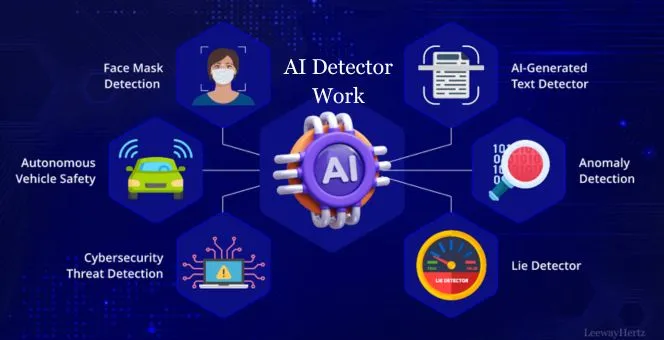
How Does an AI Detector Work? A Simple but Powerful Guide
Understanding How AI Detector Spots Artificial Writing
If you have ever written something online and suddenly worried, “Will this be flagged as AI-written?”, you are not alone. AI detector for Students, bloggers, teachers, and even professionals in the USA are asking the same question.
AI detectors are becoming more common, and they are quietly shaping how content is judged. But how do these tools really work? Are they smart enough to read like humans? Or do they just guess?
In this guide, you will learn how an AI detector works clearly and honestly. No heavy terms. No confusing science. Just a step-by-step explanation that even a 6th-grade student can understand, while still being deep enough for serious readers.
What Is an AI Detector?
The AI detector examines text to see if the content was created by an AI program or by a proper human author. AI detectors do not know the meaning/understanding as humans do. It looks for writing patterns.
These patterns come from how AI usually writes compared to how naturally humans write. Think of it like a handwriting checker. It will not know who wrote the note, but will tell if the writing is too rigid or too perfect.
Why AI Detectors Exist in the First Place
AI writing tools are everywhere now. That created both excitement and concern.
The main reasons AI detectors are used
- Schools want to check original student work
- Publishers want human-written articles
- Companies want authentic marketing content
- Search engines want helpful, real content
This is why AI detectors matter. They try to protect trust, fairness, and originality. But here is the key point: detection is not always accurate.
How Does an AI Detector Work Behind the Scenes?
AI detectors rely on data and probability, not certainty. They analyze text using several signals together.
1. Pattern Recognition in Writing
AI models often repeat certain sentence structures. This happens frequently in AI Tools for Content Creation, where balanced phrases, even tone, and predictable flow are used to generate fast and consistent text.
Human writing usually has:
- Small mistakes
- Uneven rhythm
- Emotional jumps
- Personal phrasing
Detectors compare your text against known AI writing patterns and score how similar it looks.
2. Predictability of Words
This is one of the most important signals. AI tends to choose words that statistically “fit best” after the previous word. Humans are more random and emotional. If a sentence feels too smooth or too expected, the detector raises a flag.
Example idea:
Humans surprise readers. AI often plays it safe.
3. Sentence Structure Analysis
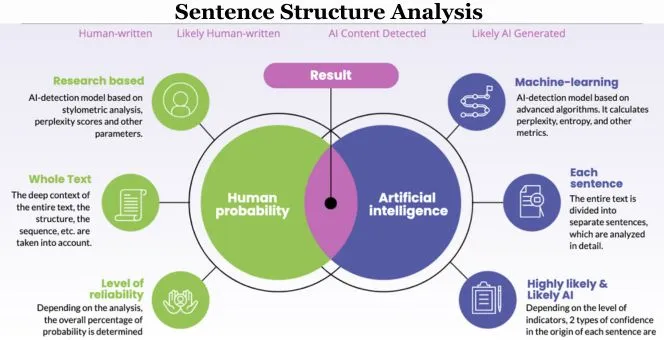
AI usually writes sentences of similar length and style.
Detectors look for:
- Repeated sentence patterns
- Overly balanced paragraphs
- Lack of natural pauses
Human writing has variety. Short lines. Long thoughts. Sudden emphasis.
Key Metrics AI Detectors Use
After basic analysis, detectors apply scoring models. These scores do not mean “true or false.” They mean “likely or unlikely.”
Perplexity
Perplexity measures how predictable the text is.
- Low perplexity = very predictable = likely AI
- High perplexity = more surprising = likely human
Human writing usually has higher perplexity.
Burstiness
Burstiness checks variation. Humans write in bursts. Short sentences followed by long ones. Emotional spikes. AI writing is smoother and more evenly spaced. Low burstiness often signals AI-generated content.
Types of AI Detectors You May Encounter
Not all detectors work the same way. Some are stricter than others.
Rule-Based Detectors
These use fixed rules.
They look for:
- Repetitive phrasing
- Formal tone
- Generic transitions
They are fast but not very flexible.
Machine Learning-Based Detectors
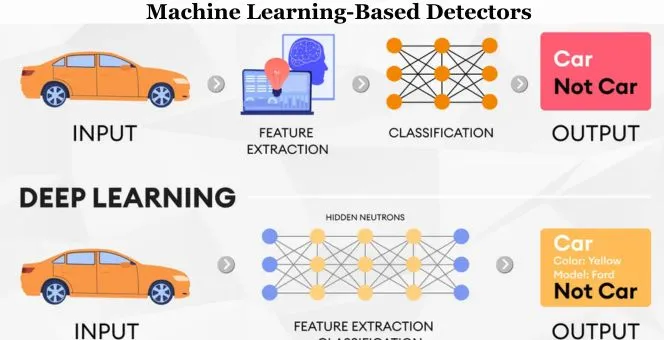
These are trained on large datasets of AI and human text. They learn patterns instead of following rules. These are more advanced but still imperfect.
Hybrid Detection Systems
These combine rules, machine learning, and probability scoring. They are commonly used in academic and publishing environments.
Why AI Detectors Can Be Wrong
This is important to understand. AI detectors do not read meaning. They read style. That leads to problems.
Common reasons for false results
- A human writes very formally
- A non-native speaker writes simple sentences
- An editor heavily rewrites content
- AI text is manually improved
A well-edited AI text can pass as human. A clear human text can be flagged as AI. That is why results should never be treated as the absolute truth.
Can AI Detectors Detect Edited or Humanized AI Content?
Sometimes yes. Often no.
When AI text is rewritten with:
- Personal examples
- Emotional tone
- Natural transitions
Detection becomes much harder. Detectors struggle when content shows real intent, opinion, or storytelling. This proves one thing clearly: Style matters more than origin.
Ethical and Practical Considerations
AI detectors raise serious questions.
Is it fair to rely only on detectors?
Not always. A score does not equal cheating. It only suggests similarity. That is why many experts recommend using detectors as a guide, not a judge.
How Writers Can Stay Safe and Authentic
You do not need to fear AI detectors if you write honestly.
Smart writing practices
- Add real insight, not filler
- Vary sentence length
- Use natural language
- Avoid robotic transitions
- Write as you speak
Human writing has personality. Detectors notice that.
The Future of AI Detection

AI detectors will improve, but so will AI writing. This is an ongoing cycle. In the future, detection may focus less on style and more on intent, originality, and value. What will always matter most is usefulness to the reader.
Final Thoughts
So, how does an AI detector work? It does not read minds. It does not know who you are. It only measures patterns and probabilities. AI detectors look for predictability, structure, and writing rhythm.
They guess based on data, not certainty. The best way to pass any detector is simple. Write clearly. Write honestly. Write for humans. When content feels real, helpful, and thoughtful, it naturally stands out.
FAQ’s
AI detectors only estimate based on writing patterns. They can make mistakes and should not be treated as final proof.
Clear, simple, or very polished writing can look predictable, which may confuse detection tools.
They analyze structure, word choice, and patterns, not the actual message or intent.
Adding natural flow, personal insight, and varied sentence styles can lower AI signals.